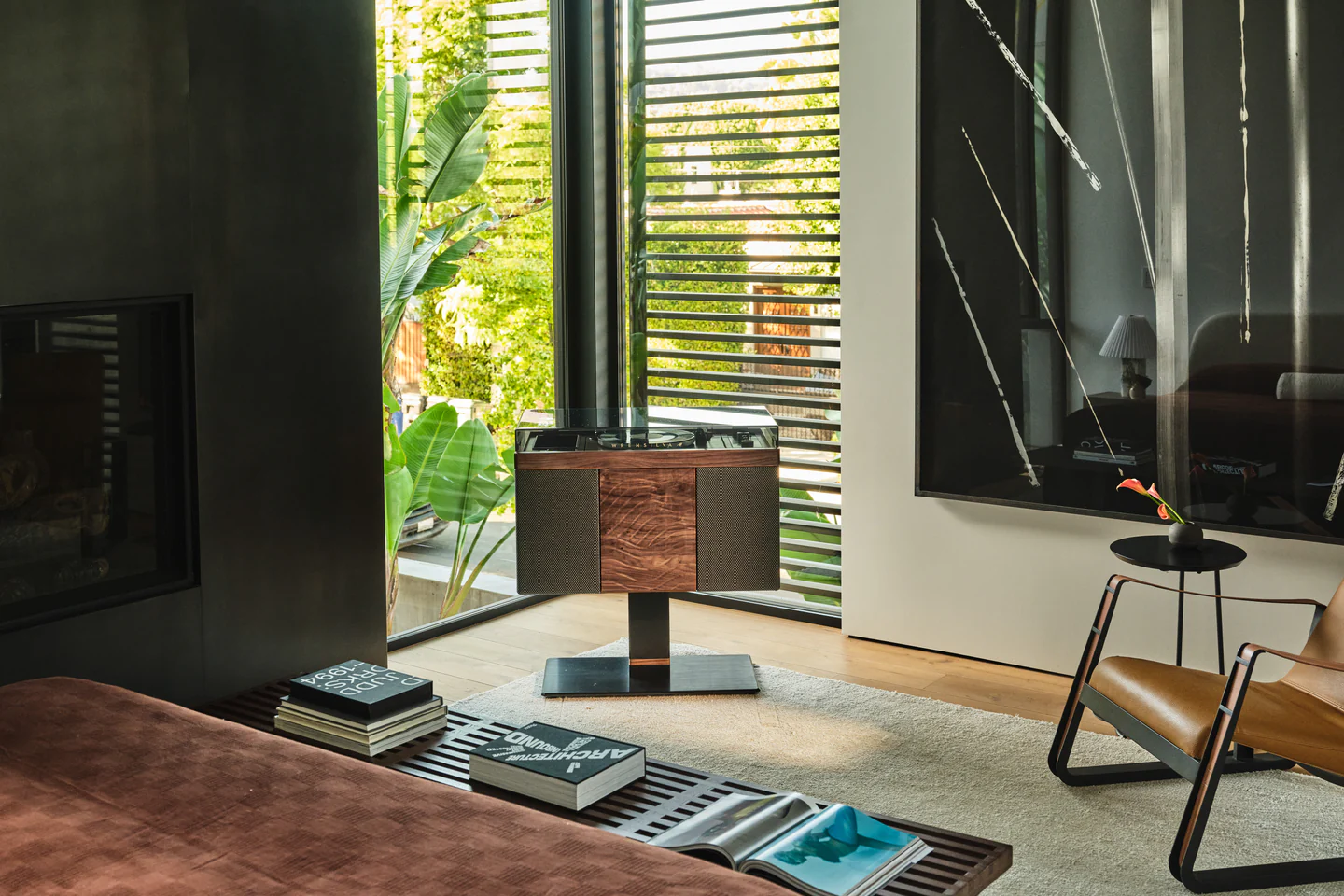

Audio equipment has always created a particular kind of tension in residential design. The client wants music in the room, while the designer is trying to protect the visual intent of the room.
Traditional component systems solve the listening problem well. They also introduce a group of visible objects that have to be placed, connected, ventilated, and visually managed.
That can quickly turn into a design compromise. A turntable needs a stable surface, the amplifier needs a home, and speakers need enough room to perform properly.
Built-in cabinetry can help conceal the system, but it adds cost and permanence to a category where clients may want flexibility later. Media furniture can help organize the equipment, but it rarely solves the deeper issue of how the system actually looks and sounds in the room.
For years, designers have worked around that conflict. Equipment gets hidden in closets, speakers disappear into walls, and the stereo becomes something to minimize rather than something to place with confidence.
That approach can preserve the room visually, but it often takes something away from the listening experience. The system becomes a problem to hide instead of an object that contributes to the character of the space.
Why The Record Console Format Solves The Conflict
The return of the record console is happening because it resolves that old friction at the object level. The audio system and the furniture are no longer competing for space, because they are designed as the same piece.
A hifi record player cabinet gives the turntable a proper home inside an object that already belongs in a finished interior. The amplification is integrated, the speakers are built into the form, and the records have a place to live.

That matters for designers because the piece arrives as a room element rather than a technical problem. It can anchor a wall the way a credenza would, while also serving as the listening system the client actually wants to use.
The format has a long precedent. Midcentury consoles worked because they understood that music was part of the room, not an accessory that needed to be hidden afterward.
The reason the category faded was not that the furniture stopped making sense. The problem was that the audio inside could no longer compete with separate components as expectations changed.
Modern engineering has made the format credible again. Better amplification, improved isolation, and more thoughtful acoustic design have allowed the record console to return as a real specification option rather than a nostalgic decorative object.
What Makes Wrensilva Specifiable
A piece earns its place on a designer’s specification sheet by doing more than looking attractive in a showroom. It has to adapt to different interiors, justify its presence to the client, and hold up as a meaningful furnishing in the completed room.
Wrensilva is built for that conversation because the visual language is customizable without becoming overly complicated. The wood choices allow the same format to move between very different design directions.
Natural Walnut reads warm and familiar, especially in rooms with midcentury references. White Oak shifts the object toward a lighter coastal or Scandinavian register, where the piece can feel quieter and more architectural.
Tobacco Walnut creates a richer presence. Blonde Mahogany brings the form into a brighter and more contemporary mood, especially when the project needs warmth without visual heaviness.
The scale options also matter. The M1 at 70 inches has the presence of a substantial credenza and can hold a larger wall without feeling tentative.
The Standard at 59 inches gives designers a more compact way to specify the category. It still has enough visual weight to matter, but it fits spaces where a larger console would overstate the room.

Speaker presentation becomes another design lever. Leaving the speakers uncovered gives the cabinet a more architectural read, especially when the horizontal wood grain becomes part of the front elevation.
Using duo-weave fabric softens the object. It makes the console feel more textile-forward and allows the piece to coordinate more closely with upholstery, rugs, and other materials already in the room.
Wrensilva’s trade program reinforces that the brand understands the design process. For designers, that matters because specification depends on more than the object itself. It also depends on support, ordering clarity, and the ability to place the piece confidently within a project.
Why Integrated Audio Changes The Design Conversation
A record console cannot succeed on furniture alone. If the client eventually has to add separate speakers or supplemental components, the original design advantage starts to disappear.
That is why integrated engineering matters. The audio system has to be designed for the cabinet, not placed inside it after the furniture is complete.
When the speakers are matched to the enclosure, the cabinet becomes part of the listening system. When the turntable is isolated properly, the furniture can support vinyl playback without turning vibration into a performance problem.
This is the point that separates a serious modern console from a decorative cabinet with a turntable installed in it. The designer is not specifying a disguise for audio equipment. The designer is specifying the audio system as furniture.
For clients who care about sound, that distinction is essential. They want the room to look finished, but they still expect the music to justify the investment.
The Social Value Of A Record Console
The strongest interiors are not only visually resolved. They also shape what people do once they enter the room.
A record console changes that behavior because it invites interaction. Guests move toward it, look through albums, ask about the wood, and participate in choosing what the room will sound like.
That is different from most anchor furniture. A credenza may hold objects beautifully, but it does not usually change the pace of an evening.
A record console does. It pulls attention away from the screen and toward a shared decision, which is part of why the format works so well in rooms designed for entertaining.
For family spaces, it can create the same effect in a quieter way. The object gives people a reason to gather, listen, and stay in the room longer.
That social function is difficult to replicate with passive furniture. The console is not just occupying the wall. It is giving the room something to do.
Why Designers Are Returning To The Category
Record player cabinets left designer specification sheets because the audio compromise became too large. The furniture remained appealing, but the performance gap made the format difficult to defend for clients who cared about sound.
They are returning because that compromise has narrowed. Modern record consoles can now offer the visual coherence designers want while delivering the listening experience clients expect.
That makes the category unusually useful in residential projects. It can function as furniture, audio system, and social anchor without requiring the designer to solve each of those needs separately.
For designers looking for a piece that can carry that much responsibility in a room, Wrensilva represents one of the most design-intentional options in the category. Its trade program is available through the company’s website for professionals specifying the piece into residential projects.
Wrensilva
+18002926353
1995 Main St, San Diego, CA 92113